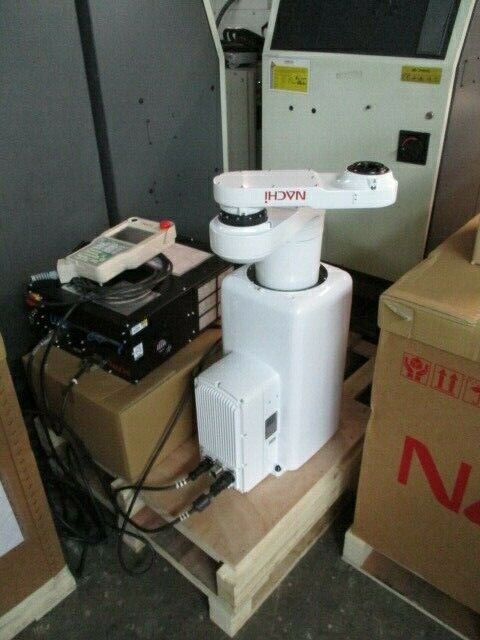
Information about Nachi robots
If you have aRobot NachiSelecting a robot in practice involves a precise match between robot type, workspace, cycle time requirements, and integration (e.g., grippers, sensors, networks, additional axes). NACHI covers several robot types and typical automation scenarios – from assembly and machine tending to welding applications.
Functionality and series overview
Within the NACHI portfolio, four lines are particularly relevant for many industrial projects: TheMZ seriesThe range includes compact 6-axis industrial robots with internal cable and wiring routing and a hollow wrist for low-collision operation in confined spaces. The key specifications for the MZ selection shown on the German manufacturer's website are payload capacity from 1 to 25 kg, reach from 350 to 1882 mm, and repeatability up to 0.02 mm.
For collaborative applications, NACHI offers theCZ10It is a slim, touch- and pressure-sensitive robot arm that can be programmed to positions by manual guidance. Key features include a 10 kg payload capacity, a reach of up to 1300 mm, IP54 protection class, and ISO 10218-1 certification.
For heavy loads and welding applications, theSRA seriesDesigned for heavy-duty spot welding guns and seam welding equipment, it is also described as suitable for handling large components. Key specifications include a load capacity of 100 to 250 kg and a reach of 1634 to 2951 mm.
For pick-and-place and assembly in confined spaces, theEZ seriesIt is described as a space-saving robot with an overhead design and vertical movement in the first axis; the manufacturer's website mentions four- and six-axis variants, payload capacity of 2 or 3 kg, reach of up to 550 mm and repeatability of up to 0.014 mm.
Areas of application and typical uses
NACHI describes robotics solutions for loading and unloading tooling and injection molding machines, spot and path welding (e.g., in the automotive and steel construction industries), pick-and-place, packaging and palletizing, as well as positioning and assembly of small parts in electronics manufacturing. For your project selection, it helps to match these application areas directly with the appropriate series: MZ for universal handling and precise positioning, EZ for rapid assembly/placement in compact layouts, CZ for collaborative assembly scenarios, and SRA for heavy-duty welding and handling tasks.
Advantages and special features of NACHI solutions
The MZ series prioritizes a compact, slim design, internal cable routing, and a hollow wrist – practical when the cell is confined and you want to minimize interfering edges (e.g., external hoses). High feed rates and high repeatability are also emphasized for precise handling and positioning.
The mounting concept is a key factor in the EZ series: Overhead installation saves floor space because no floor space is required for the robot. The EZ series brochure illustrates this with a significantly reduced cell footprint (40% in the example) and shorter travel distances compared to floor-mounted SCARA concepts.
For collaborative work with the CZ10, the "carrying" programming principle is relevant, as are the manufacturer's specified specifications (IP54, ISO 10218-1). Regardless of the robot, whether an application is feasible without a safety fence always depends on the specific risk assessment and the overall system (tool, workpiece, speed, environment).
Selection, purchase and classification in the project
For a reliable pre-selection, you should structure your decision along a few, clear criteria – and then compare these with data sheets/manufacturer specifications:
- Robot type: 6-axis (MZ/SRA) for flexible spatial movements, SCARA/compact assembly (EZ) for high dynamics in compact layouts, collaborative (CZ10) for human-robot collaboration.
- Load & Range: oriented towards the workpiece, gripper, additional components and the actual workspace (including safety distances).
- Assembly concepte.g. overhead (EZ) vs. classic cell assembly – relevant for floor space and accessibility.
- Protection class: depending on the environment (e.g. IP67 for several MZ models on the manufacturer's website; IP54 for the CZ10).
- Control & IntegrationNACHI describes Windows-based controllers with a teach pendant; vision and force sensors as well as networks are managed centrally. Depending on the controller, additional axes are possible (e.g., 6 controllable, up to a maximum of 8), and extensive I/O and programming capabilities are specified.
When comparing purchasing options, it's also worth considering the integration aspects: gripper and tool design, connection to your line control system, safety concept, and the availability of suitable controller/robot variants for your layout. You can find technical reference pages on the manufacturer's website at [website address].NACHI product portfolio robotsas well as in the controller overviews.
Other typical questions
Which series is particularly suitable for narrow cells?
When space is limited, compact designs and collision-free media routing are crucial. For the MZ series, internal cable and conduit routing as well as hollow wrists are explicitly mentioned to enable operation in confined spaces.
What makes the CZ10 stand out in the shop context?
The CZ10 is described as a collaborative robot arm that is touch- and pressure-sensitive and can be programmed by manual movement. Whether this is feasible in your application "without a fence" must always be decided based on the application-specific safety assessment of the overall system.
Which control system is relevant – and what should I pay attention to?
NACHI describes controllers that are operated via a teach pendant and also centrally manage vision/force sensors and networks. The specifications mention, among other things, axis and I/O capacities as well as a robot monitoring function (PL d, optional PL e); the specific selection depends on the robot type and the planned system setup.
How can I obtain Nachi Robot Germany and classify it appropriately?
For procurement, it is crucial that you clearly specify the model, year of manufacture/revision (if needed), controller version, and integration requirements (e.g., additional axes, sensors, interfaces). Use the manufacturer's overviews as a technical reference and compare the desired specifications with the specific offer in the shop.